What This Covers
One sheet of siding off a wall is as normal a call as a whole gable end. Small openings are how the next storm gets inside, so the make safe work comes before the rebuild.
Make Safe
- Emergency tarping over an opening to keep weather out
- Board up for broken windows and doors that will not latch
- Downed limbs cleared off the roof, fence, and driveway
- Wet material pulled out and dried before anything gets closed up
Rebuild
- Siding replaced where wind stripped a wall or gable end
- Gutters and downspouts re-hung after wind, ice, or a limb
- Window glass and screens after hail or flying debris
- Fence sections and gates reset or rebuilt after a wind event
- Fascia, soffit, and trim where water got in behind it
- Drywall and insulation cut back and rebuilt after a ceiling leak
Claim Side
- Damage photographed before anything gets covered up
- A written scope of the repair to hand your adjuster
- Walking the damage with the adjuster when they come out
- Repairs staged by priority, dry and secure first
How Storm Repair Work Usually Goes
Storm calls start with what you can see. A section of siding out on the lawn, a limb across the fence, a wet ring spreading on a ceiling. That visible damage is rarely the urgent part. Whether the building envelope is still closed is the urgent part, because as long as there is an opening, the damage keeps growing every night the wind comes back.
Wind is the main event out here. It crosses open farm ground with nothing to slow it down and finds the weak edge first, a gable end, a lifted course of siding, a fence line that was already leaning. Then the freeze and thaw cycle works at whatever got opened, and blowing dust packs into the gap behind it. The leak you find in February often started as a small opening back in October. Roof tear-offs and anything structural go to a licensed roofer or a structural engineer, and we tell you that instead of guessing at it.
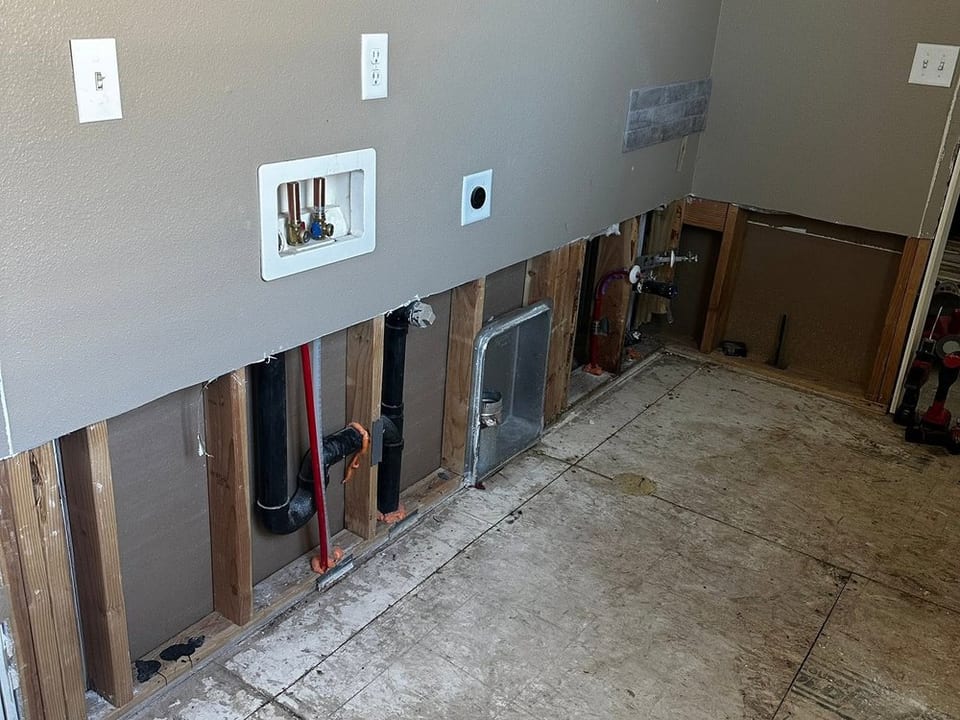
On the insurance side, be clear about who decides what. We do not decide what your policy covers, your adjuster does, and nobody here is going to tell you a claim will be approved. What we can do is photograph what we find, write the repair up in terms an adjuster can read, and be on site when they walk the property. The scope does not change based on what the claim pays, because the repair is the repair. A laundry and bathroom rebuild after a water loss shows the stripped-back stage most people never see.
Questions
Storm Damage Questions
What people ask in the first day after damage, answered plainly rather than carefully.
Should I call you or my insurance company first?
Stop the damage first, then make the call. If water is coming in or the house will not close up, the priority is the opening, not the paperwork. Read your own policy on what it asks you to do to prevent further loss, because your policy is the one that decides that, not us.
Photograph it before anything gets covered up. Wide shots of the room or wall, then close ups of the damage itself, and keep whatever came off the house. Once a tarp goes on or a wall gets opened, the original condition is gone and the photos are all that is left of it. What is covered is between you and your carrier, and we work from whatever scope comes out of that.
Do you handle the insurance claim for me?
No, and anyone who says otherwise is promising something they cannot deliver. We are a repair contractor, not a public adjuster. We do not negotiate your claim, interpret your policy, or tell you what it will pay. Adjusting is a separate licensed role and it is not ours.
What we do is the part on our side of that line. We photograph what we find, write the repair up as a scope an adjuster can read line by line, and meet them at the house so the walk covers the whole building and not just the obvious part. If their list misses something we found, we point at it on site and put it in writing. The decision stays theirs.
Is it worth filing a claim for damage this small?
Sometimes it is not, and that is worth knowing before you file. One fence panel, a length of gutter, or a piece of trim off a gable can land under your deductible, and filing is a decision with more to it than the repair itself. Your agent is the right person to ask, not us.
What changes the answer is what sits behind it. Damage that looks like one panel is often a fastening pattern that let go across the whole wall, and a stain on a ceiling is the visible end of wet insulation you cannot see. We open up enough to find out which one you have before anyone decides anything. If it really is one panel, we will say so and fix the one panel.
How fast can somebody get out here after a storm?
We answer emergency calls around the clock, and after a big wind the calls all come at once. So the honest answer is that we triage. Anything open to the weather goes first: a hole in the roof, a window on the ground, a door that will not close. A leaning fence or a bent length of gutter waits, because it is not getting worse tonight.
The first visit is about stopping the loss, not finishing the repair. Tarps, boards, and drying come first, and the rebuild gets scheduled once the house is closed up. If water reached wiring or a panel, it stops there and goes to a licensed electrician before anything is closed back up. We would rather tell you where you sit in the line than promise a window we cannot hold.
Ready to get it done?
Tell us about the project, or call and talk it through.