What This Covers
One broken picket or a gate that stopped latching is a normal call, not too small to bother with. Fence trouble travels down the line, so the small repair is the early one.
Fence Repairs
- Posts reset or replaced where the wood has gone soft at grade
- Leaning runs pulled back to plumb and braced
- Wind damaged panels and pickets put back up
- Loose boards and rails where nails have backed out
- Rot cut back on bottom rails that sit in dirt
Gate Work
- Sagging gates rehung to swing and latch square
- Hinge and latch hardware sized for the weight
- Gates that drag reset for ground clearance
- Gate frames rebuilt and braced to hold square
New Runs
- New fence runs laid out and posts set on the property line
- Privacy, picket, or ranch rail built to suit the yard
- Shadowbox and spaced picket layouts that let the wind through
- Fence staining and sealing against the long dry summer
How Fence and Gate Work Goes
Most fence calls start with what you can see from the driveway. A run has gone crooked, a few pickets are loose, the gate will not latch without lifting it. Those are symptoms, and they are rarely what decides the job. The posts decide it, and specifically what is happening where they meet the ground. We start there, because a straight panel screwed to a failing post goes crooked again.
Fences here fail two ways, and both are local. Wind is the first. A solid privacy fence is a sail, and the wind load lands on the posts, not the boards, which is why a run can lean with every picket still sound. Water is the second, and it usually is not rain. In irrigation country the sprinklers hit the bottom of a fence all summer, so posts rot at grade in a place that barely rains. Then freeze and thaw lifts what is already loose, and the gate that latched in October binds in January.
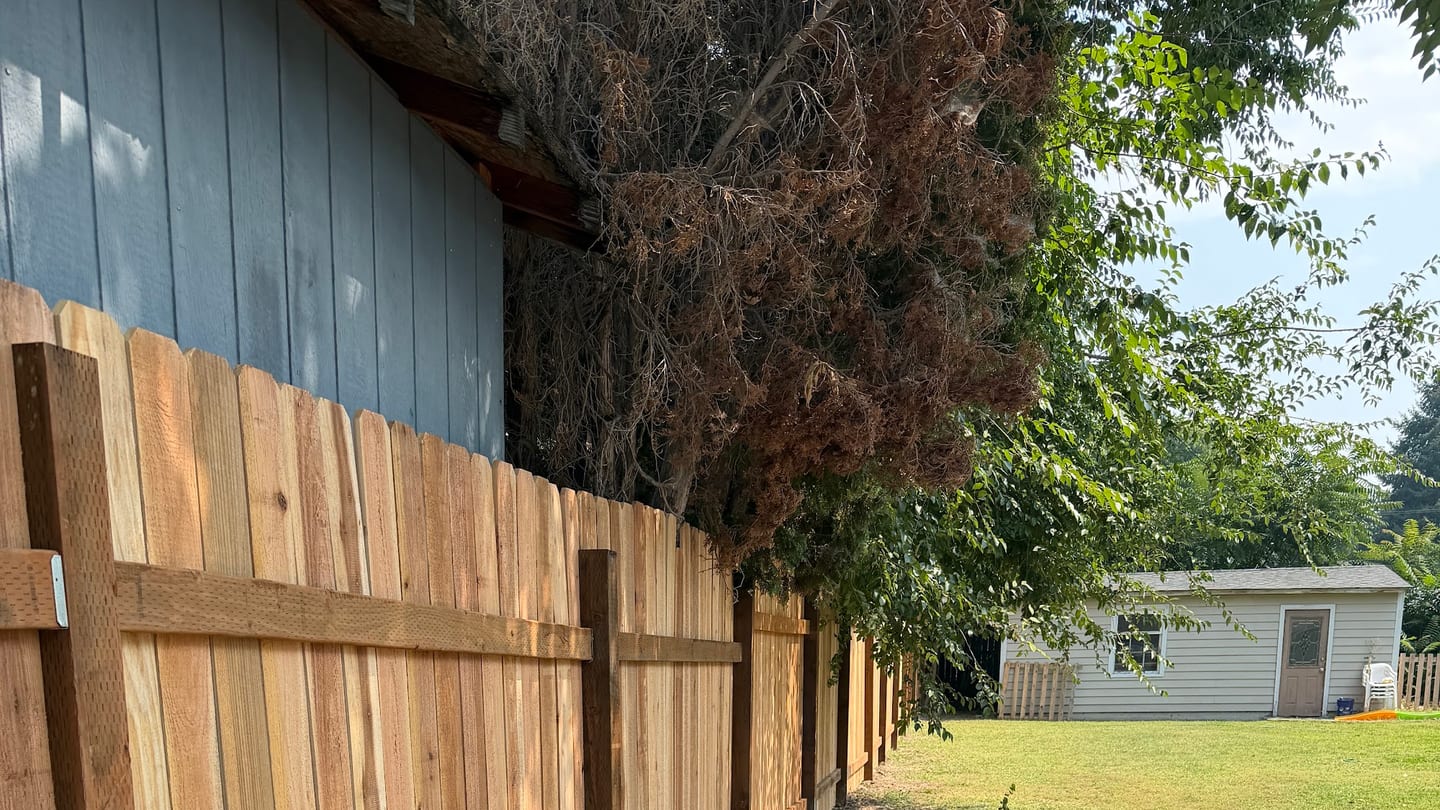
So the honest answer usually splits the run. If the posts are still solid, new boards and reset hardware put the line back without rebuilding it. If they are not, we say so, because bolting good panels to bad posts only buys a season. Gates get looked at on their own, since a gate is the part of the fence that moves and the part that fails first. Whichever way it goes, you hear what we found at the post line and why it points where it does. A cedar run we replaced along a gravel drive shows what a rebuild looks like when the old posts have given up.
Questions
Fence Questions
The questions that come up before a fence or gate job starts, answered the way we would answer them standing at the line with you.
Is this fence worth repairing, or does the whole thing need to go?
Push on the posts, not the panels. Boards and pickets are the easiest part of a fence to replace and the part everyone looks at. The posts and rails are what hold the line, and they fail from the ground up, so the damage is usually below your eye level or just under the dirt.
If most posts are still firm, repair is the honest call. Replacing a few posts, straightening the run, and putting on new boards puts the fence back on sound footing. When posts are going soft up and down the whole line, patching means coming back next season for the next one, and we would rather tell you that at the estimate than sell you the same fence twice.
My gate has dropped and catches on the ground. Can that be adjusted?
Usually it is the hinge post, not the gate. A gate hangs its whole weight off one post and works that post like a lever every time somebody swings it. The post leans a little, the latch side drops, and the gate starts catching on the ground or missing the latch. The gate itself is often still square.
So the order is post, then frame, then hardware. Reset or replace the hinge post and brace it for the swing, bring the frame back to square, and hang it on hinges and a latch rated for the weight rather than the light set that came in the kit. Wide gates for a truck or a trailer need that even more. If you want an opener on it, the gate work is ours and the power is a licensed electrician's.
What actually makes a fence stand up to the wind out here?
The posts and how they are set decide it, not the thickness of the boards. A solid privacy fence catches the wind like a sail. Everything the wind pushes on ends up in the posts and in the ground around them, so post depth, hole size, how the concrete or gravel is packed, and the bracing at corners and ends are what carry it. Heavier pickets on shallow posts just give the wind more to grab.
The other lever is letting some air through. A shadowbox layout, a spaced picket, or a lattice top gives the gusts somewhere to go and takes load off the line, and it is a choice worth making before the posts are in the ground rather than after the first big blow. Soil matters too, since what holds well in one yard drains and shifts in the next.
Do I need a permit, and what about the property line?
The line matters more than the permit, and it is the part that bites later. Rules differ by city and county here on height, corner sight lines, and how close to the road a fence can sit, and an HOA can be stricter than either. Some fences need a permit and some do not. If you and a neighbor share the run, that is a conversation worth having before posts go in the ground, not after.
Nothing gets dug until there is a utility locate. Yards here are full of irrigation mains, sprinkler laterals, and low voltage lines that rarely run where you would guess. If the fence is also holding back grade, that is a retaining wall and the structural side belongs to an engineer. We will say plainly which parts are ours and which need a licensed trade.
Ready to get it done?
Tell us about the project, or call and talk it through.